
How Much Does a Motorola MOTOTRBO Digital Radio System Cost for a Mid-Sized Warehouse?

A professional Motorola MOTOTRBO digital radio system for a mid-sized warehouse typically costs between $3,000 and $25,000 USD, depending on coverage requirements, number of users, communication capacity, and whether the system requires repeaters, dispatch consoles, or advanced trunking features.
For most warehouses with 30-150 employees, the real engineering decision is not simply choosing radios. The critical factors are:
- Whether handheld radios can penetrate steel structures, racks, and multiple warehouse zones.
- Whether the system can support simultaneous communication between logistics, security, maintenance, and management teams.
- Whether future expansion requires additional users, buildings, or remote sites.
- Whether the communication system can operate reliably during emergencies.
A properly designed Motorola MOTOTRBO system should be treated as an industrial communication infrastructure, not as a simple walkie-talkie purchase.
Typical Cost Range for a Mid-Sized Warehouse Motorola MOTOTRBO System
| Warehouse Size | Users | Recommended System | Estimated Budget |
|---|---|---|---|
| Small Warehouse | 10-30 users | Motorola digital radios + chargers | $2,000-$6,000 |
| Medium Warehouse | 30-150 users | MOTOTRBO radios + repeater system | $8,000-$25,000 |
| Large Distribution Center | 150+ users | Capacity Plus / Capacity Max system | $25,000-$100,000+ |
The final price depends more on the radio system architecture than the radio quantity itself. A warehouse with 50 radios may require a more expensive system than a warehouse with 150 radios if the building structure creates difficult RF coverage conditions.
What Determines the Cost of a Motorola Warehouse Radio System?
1. Number of Radio Users
The first calculation is the number of active users, not employees. A warehouse with 200 employees may only require 50 radios because only certain departments need real-time communication.
Typical allocation:
- Warehouse operators: 1 radio per working team
- Forklift operators: Dedicated radios
- Security team: Dedicated radios with emergency functions
- Maintenance team: Radios with better audio performance
- Supervisors: Radios with priority communication
2. Building Structure and RF Coverage
Coverage is usually the biggest hidden cost in warehouse communication projects.
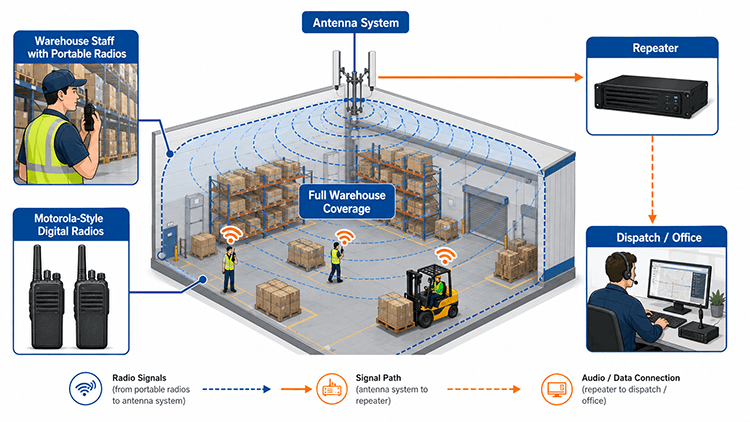
A warehouse is a challenging RF environment because of:
- Metal racks blocking radio signals.
- Large storage areas creating dead zones.
- Concrete walls and underground areas reducing signal strength.
- High ceilings causing signal reflection and multipath interference.
A direct radio-to-radio system may work in an open area, but many warehouses require a repeater to achieve reliable indoor coverage. Motorola MOTOTRBO repeaters such as the SLR series are designed to support analog and digital operation and can scale from conventional systems to larger MOTOTRBO architectures.
3. Required Communication Features
Professional warehouses usually require more than voice communication.
| Feature | Business Value |
|---|---|
| Group Call | Allows logistics teams to coordinate quickly |
| Emergency Button | Improves worker safety response |
| Encryption | Protects operational communication |
| GPS Location | Improves fleet and worker management |
| Dispatch System | Centralized communication control |
Example: 80-User Warehouse Motorola MOTOTRBO System Cost Calculation
The following example represents a typical medium-sized logistics warehouse:
- Warehouse area: 20,000-50,000 square meters
- Users: 80 employees
- Coverage requirement: Entire warehouse + loading area
- Communication groups: Logistics, Security, Maintenance, Management
- Requirement: Reliable digital communication with emergency capability
| Equipment | Quantity | Estimated Cost |
|---|---|---|
| Motorola MOTOTRBO Portable Radios | 80 units | $12,000-$20,000 |
| Digital Repeater | 1 unit | $2,500-$6,000 |
| Programming & Channel Planning | 1 service | $300-$1,500 |
| Antennas, Duplexer, Installation | 1 system | $1,000-$5,000 |
Total Estimated Investment: $15,000-$30,000 USD for a professionally installed Motorola MOTOTRBO warehouse communication system.
Why Two Warehouses Buying the Same Number of Motorola Radios Can Have Completely Different Costs?
The biggest mistake made by many companies is calculating a radio system budget based only on the number of handheld radios.
A professional MOTOTRBO system cost is mainly determined by three engineering factors:
- RF coverage requirement: How far and how reliably radios must communicate.
- Communication capacity: How many teams need simultaneous conversations.
- System architecture: Conventional, repeater-based, or trunking system.
Example Comparison
| Project A | Project B |
|---|---|
| 50 radios in an open outdoor storage yard | 50 radios inside a 40,000㎡ metal warehouse |
| Direct digital communication | Repeater required |
| No infrastructure | Repeater + antenna system + programming |
| Estimated budget: $5,000-$8,000 |
Estimated budget: $15,000-$30,000 |
The radios may be identical, but the communication engineering requirement is completely different.
Choosing the Correct Motorola MOTOTRBO System Architecture for a Warehouse
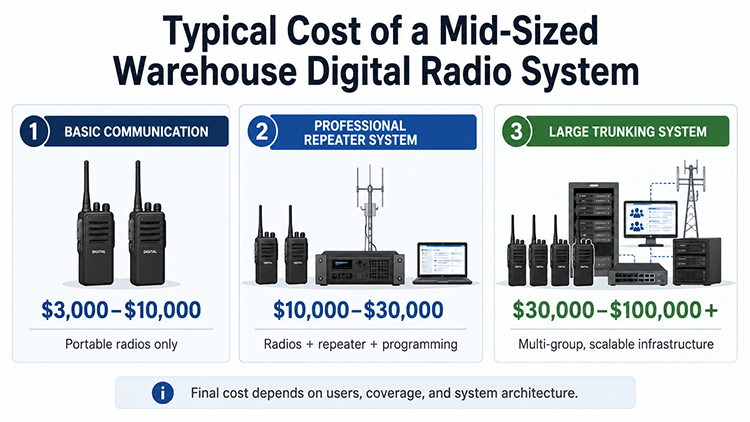
For a mid-sized warehouse, there are usually three possible system designs:
Option 1: MOTOTRBO Digital Conventional System
Recommended for: Small warehouses, simple communication requirements, limited users.
- 10-50 radio users
- Single building
- Low communication traffic
- No complex dispatch requirement
Typical investment: $3,000-$10,000 USD
Option 2: MOTOTRBO Repeater System
Recommended for: Most medium-sized warehouses.
A repeater system is usually the correct solution when:
- Signal cannot cover the entire warehouse.
- Workers operate between indoor and outdoor areas.
- Steel structures create dead zones.
- Multiple departments need separated communication groups.
Motorola SLR series repeaters support MOTOTRBO digital communication and can be used in systems ranging from conventional operation to larger networked architectures. :contentReference[oaicite:0]{index=0}
Typical investment: $10,000-$30,000 USD
Option 3: MOTOTRBO Capacity Plus / Capacity Max
Recommended for: Large warehouses, logistics hubs, industrial campuses, and companies expecting future expansion.
- Many communication groups
- High radio traffic
- Multiple buildings
- Advanced management requirements
MOTOTRBO Capacity Plus is designed as a scalable single-site digital trunking solution and can support large numbers of radio users while improving channel efficiency. :contentReference[oaicite:1]{index=1}
For enterprise-level deployments, Capacity Max provides a scalable DMR Tier III architecture designed for large organizations, supporting multi-site deployments and thousands of users. :contentReference[oaicite:2]{index=2}
Typical investment: $30,000-$100,000+
Motorola MOTOTRBO Radio Model Selection for Warehouse Applications
| Model | Positioning | Warehouse Application | Recommended Users |
|---|---|---|---|
| Motorola DP2000e Series | Entry professional digital radio | Basic logistics communication | Small & medium teams |
| Motorola DP4000e Series | Advanced professional portable radio | Warehouse supervisors, security, maintenance | Professional users |
| Motorola R7 | Premium industrial digital radio | High-noise environments | Critical operations |
| Motorola DM4000e Series | Mobile/base radio | Control rooms, vehicles, dispatch points | Fixed locations |
Professional Engineering Process: How We Design a Motorola Warehouse Radio System
A reliable warehouse communication system should not be designed by simply selecting radio quantity.
Step 1: Analyze Warehouse Environment
- Measure warehouse dimensions and building materials.
- Identify signal obstacles including metal racks, concrete walls, elevators and underground areas.
- Determine critical communication zones: loading area, storage area, office, security gate and emergency routes.
Step 2: Define Communication Groups
A typical warehouse configuration:
| Department | Channel Group |
|---|---|
| Warehouse Operation | Operations Channel |
| Security | Security Priority Channel |
| Maintenance | Technical Channel |
| Management | Supervisor Channel |
Step 3: Frequency Planning and Programming
- Assign licensed frequencies according to local regulations.
- Configure radio IDs and talk groups.
- Set emergency functions.
- Optimize audio profiles for warehouse noise conditions.
- Perform RF testing before final delivery.
Step 4: Final Coverage Testing
Professional installation requires testing communication quality in the actual working environment.
- Voice clarity test
- Dead zone identification
- Emergency button verification
- Battery performance test
- Channel loading test
Why Choosing the Right Motorola Supplier Matters for Warehouse Radio Projects
A Motorola MOTOTRBO system is not only a hardware purchase. The final communication performance depends heavily on system design, programming, frequency planning, and after-sales technical support.
Many communication failures in warehouses are not caused by defective radios. They are usually caused by incorrect system configuration, poor channel planning, unsuitable antennas, or insufficient RF testing.
Common Problems Caused by Poor System Planning
- Radios cannot communicate in certain warehouse areas.
- Workers experience unclear audio in noisy environments.
- Different departments interrupt each other’s communication.
- Emergency functions are not configured correctly.
- Future expansion requires replacing the entire system.
Professional Supplier Should Provide More Than Hardware
- Correct Motorola model recommendation according to working environment.
- Free radio programming and channel configuration.
- Talk group planning for different departments.
- Frequency coordination support.
- Technical troubleshooting after deployment.
- Global shipping and export experience.
Motorola Solutions also emphasizes the importance of professional configuration and programming services because each MOTOTRBO device needs to be configured according to the customer’s operational requirements. :contentReference[oaicite:0]{index=0}
Recommended Warehouse Communication Package from TSHICOM
For most medium-sized warehouses, we recommend a balanced MOTOTRBO solution:
| Item | Recommendation |
|---|---|
| Portable Radios | Motorola MOTOTRBO DP Series / R Series |
| Infrastructure | Motorola MOTOTRBO Repeater System |
| Programming | Custom channel and talk group configuration |
| Accessories | Original Motorola batteries, chargers, antennas and audio accessories |
| Support | Remote technical support and troubleshooting |
Final Conclusion: How Much Should You Budget?
For a typical mid-sized warehouse, a realistic Motorola MOTOTRBO digital radio system budget is:
- Basic communication: $3,000-$10,000
- Professional warehouse system with repeater: $10,000-$30,000
- Large logistics center with trunking and dispatch: $30,000-$100,000+
The correct solution is not the cheapest radio package. The correct solution is the system that provides reliable communication coverage, enough capacity, and long-term scalability.
About Guangzhou Haode Electronic Technology Co., Ltd. (TSHICOM)
Guangzhou Haode Electronic Technology Co., Ltd. (TSHICOM) is a professional wireless communication equipment supplier specializing in Motorola MOTOTRBO digital radios, professional two-way radio systems, repeaters, accessories, and customized communication solutions. As a trusted Motorola radio supplier, TSHICOM provides original Motorola products, compatible accessories, and professional solutions covering Motorola, Icom, Kenwood, Hytera and other leading communication brands. With more than 10 years of industry experience, TSHICOM supports global customers including distributors, system integrators, security companies, logistics enterprises, and industrial users with worldwide fast delivery, technical consultation, radio programming, channel planning, and reliable after-sales support.
Frequently Asked Questions (FAQ)
Q1: How many Motorola radios does a warehouse need?
A: A medium-sized warehouse usually needs 30-150 Motorola radios depending on employee roles, communication groups, and operational requirements. The correct quantity should be calculated based on active users, not total employees.
Q2: Do I need a Motorola repeater for my warehouse?
A: Most medium and large warehouses require a repeater because metal racks, concrete walls, and large storage areas can reduce radio coverage. A repeater improves communication reliability and eliminates weak signal areas.
Q3: What is the difference between Motorola digital radios and normal walkie talkies?
A: Motorola MOTOTRBO digital radios provide clearer audio, better coverage efficiency, encryption options, GPS features, emergency functions, and professional system expansion compared with consumer walkie talkies.
Q4: Can TSHICOM help configure Motorola radios before shipment?
A: Yes. TSHICOM provides professional radio programming, channel planning, talk group configuration, and technical support before shipment to ensure radios are ready for customer deployment.
Request Your Motorola Warehouse Radio System Proposal
Every warehouse has different RF conditions, building structures, and communication requirements.
Contact TSHICOM today and provide:
- Warehouse size and location
- Number of radio users
- Required communication distance
- Current communication problems
- Preferred Motorola models (if available)
Our technical team will help design a suitable Motorola MOTOTRBO communication solution and provide a customized quotation.
Submit your inquiry form below to receive a professional system recommendation.